Support plans, evolved
A profile is "me in a nutshell"; a plan is "what we intend to do". Replacing a long, clinical document with details shared step by step, as trust grows, and fully in the client's control.
At a glance
- Situation
- Traditional support plans are long, clinical and hard to use. Clients avoided writing them, workers rarely read them, and the platform offered only a blank text box.
- Task
- Find what makes a support plan meaningful, and build those strengths into the whole product, with clients in full control of what's shared, when and with whom.
- Action
- Interviewed people about how their best client-worker relationships began, then designed details to unfold like a hiring process: public needs, interview, shift plan, then on-shift details.
- Result
- An interactive prototype and a tagged model of support needs that fed shift agendas and opened the door to matching workers by skill.
A document nobody wanted to write or read
A traditional disability support plan lists every service a person may need and exactly how to deliver it, drawing on medical instructions, personal preferences and technical documents. It can feel clinical and impersonal, and at worst overwhelming. Clients hesitated to share so much for privacy reasons, or found itemising every need exhausting. Workers felt overloaded by complex plans. Hireup's version was a blank text box.
Keep what makes a plan useful, lose the rest
Work out what makes a support plan meaningful, and build those strengths into the product as a whole, with people with disability fully in control of when, where and how their details are shared and used.
Design it the way good relationships actually start
Ask about the best relationships, not the form
Rather than asking for opinions on a blank box, I interviewed people about how their best client-worker relationships began: how duties were worked out, when the overview came up versus the detail, how terms were agreed, and when they knew it was a good match. Like most jobs, the big picture belonged up front, and early detail felt irrelevant. Clients avoided long documents, workers didn't read them, and the details were learned best on the job. Good relationships were built on open conversation and feedback, so the tool should encourage talking, not documenting.
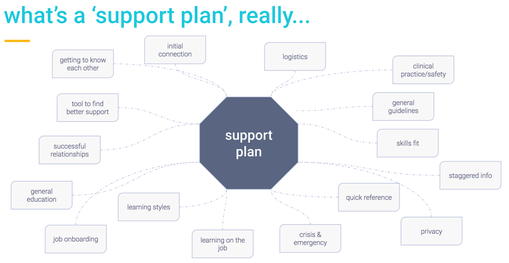
Share details as trust grows
I modelled sharing on a hiring process, revealing more at each stage. That protects the client's privacy and gives workers the context they need at the right moment:
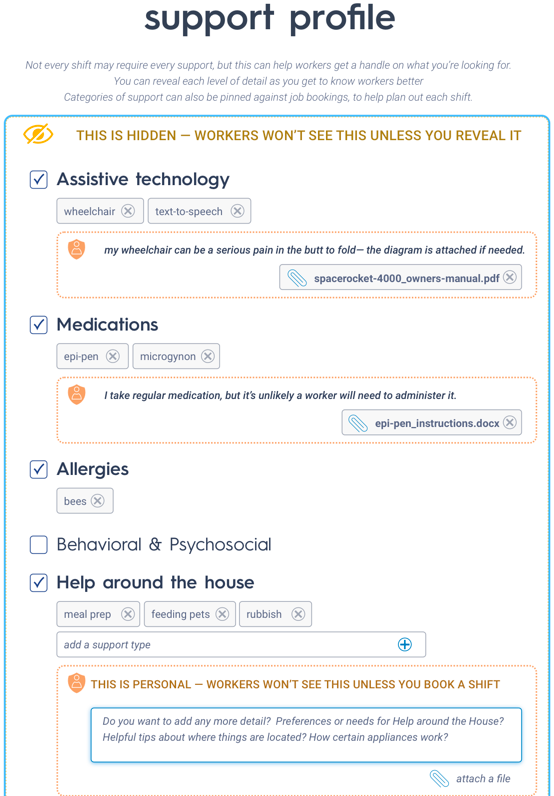
- Public profileHigh-level needs, such as help around the house or transport, with suburb, age range and interests.
- InterviewEach need becomes a talking point about what it means day to day.
- Shift planningIf both agree on the tasks, they plan a shift together.
- On shiftThe detail arrives when it's needed: wheelchair instructions, the wifi password, what the dog eats.
Make every detail reusable
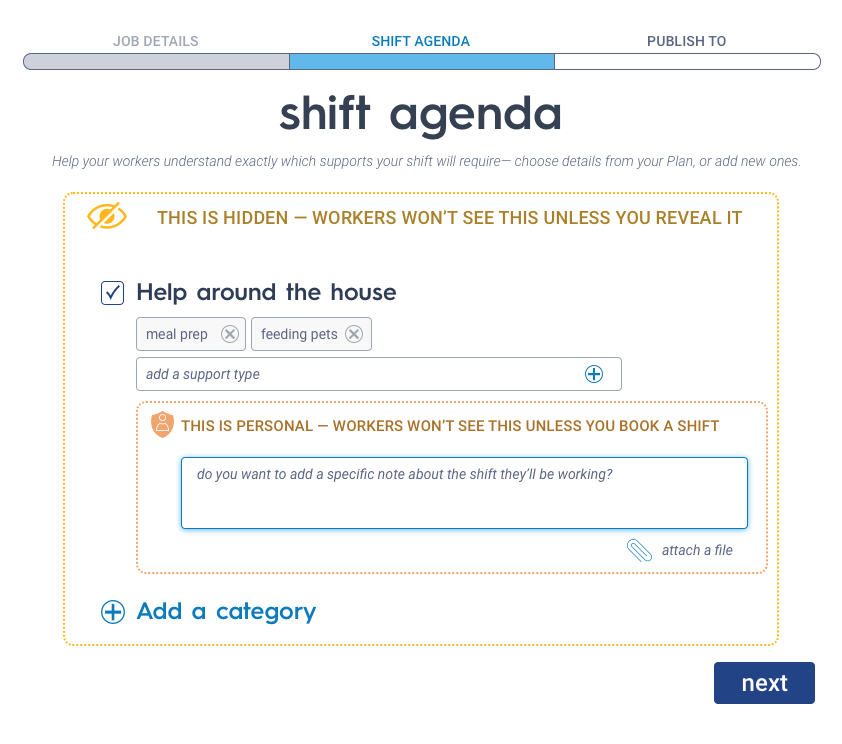
Support needs are tagged from a suggested set, which makes the form quicker to fill in and lets other features use the data. Tagged areas drop into a shift agenda as a checklist, so both sides know what's expected. The same structure could later match a need for a car with a worker who has one, or show a worker's hours of experience in a skill.
A plan that grows with the relationship
- Prototypean interactive prototype of the full flow, tested with clients and workers.
- Structuredsupport needs that fed shift agendas, with matching by skill as a next step.
- Shippedin a later version, after I'd left.
The work shaped how Hireup's product started, framed and supported conversations between the two sides of the marketplace.