Coviu: Coflow
As founding designer of a new healthcare product, I led the research that found its customers, designed the MVP, and built the way our small, AI-native team worked together. We shipped in four months.
The role at a glance
- Business
- Coviu, an Australian telehealth company, spun out Coflow: a platform that sends patients the right forms and files before each appointment and files the answers back into the practice's own system.
- Hired to
- Be the founding designer of Coviu's new spinout product, for my record of mapping unfamiliar problem spaces and spinning up greenfield MVPs: research and product–market fit first, then design for the build.
- Key wins
- A design partner program that time-poor practices stuck with, a full MVP in four months against an 18-month estimate, and one monorepo pipeline that took an average feature from concept to build in about a day.
- Result
- 90% of onboarded design partners converted to paying customers, and a high share said they'd be very disappointed to lose the product.
Less chasing, more care
Before every appointment, a practice's front desk chases paperwork: registration, consent, bulk-billing forms, referrals, questionnaires. Most of it goes out by phone, text and email, comes back incomplete, and gets typed into the practice management system by hand.
Coviu, an Australian telehealth company, set up a small spinout team to build a product for that work. Coflow by Coviu sends the right forms to the right patient at the right moment, shows the practice what's done and what needs a nudge, and files completed forms back into the patient's record. It connects to five practice management systems and runs the telehealth consult from the same place.
Map the problem, then build the MVP
Coviu brought me in for their new product: someone who could map an unfamiliar problem space and take a greenfield MVP from nothing to shipped. They hadn't had a designer for over six months, so the design practice, the research program and the tooling were mine to build.
The first two months were research and product–market fit, including whether the product could travel to the US market. The rest was design for the build, alongside a team of 13 using AI agents throughout.
Research, design and the way we worked
Won the time of a hard-to-reach audience
Practices are famously time-poor and wary of new software, and Coviu had struggled to get their attention. I designed a structured design partner program that a significant group of practices followed from first call to willingness-to-pay interviews, and built TRIFL, a research tool for tracking every partner's journey and the themes emerging across them.
Designed a lean MVP with room to grow
With AI making it easy to build almost anything, the hard part was choosing. I kept each screen to what a busy front desk needed today, and held space in the structure for what partners asked for next: more channels, conditional forms, deeper data write-back.
Brought product, design and engineering into one place
We each ran fast, AI-assisted loops, but in different tools: product docs in Google Docs, design in Claude Design and Storybook, builds in Claude Code. I built my own design tooling, and with product and engineering rebuilt how we worked around one monorepo. After that, an average feature went from concept to build in about a day.
The work, in detail
-
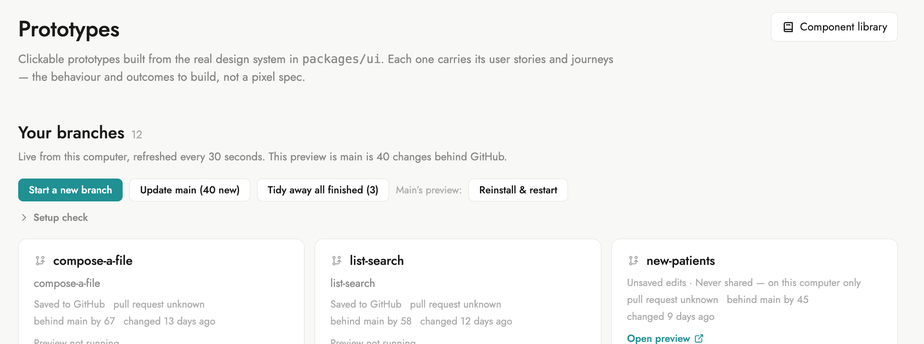 A pipeline built for speed
Bringing product, design and engineering into one monorepo, so a small team could move fast.
-
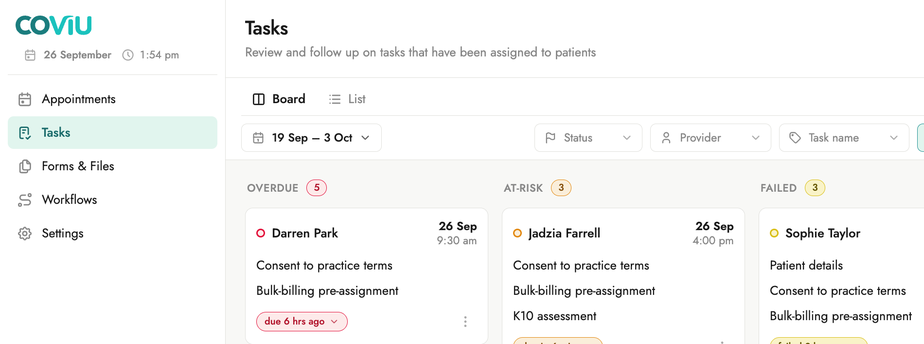 From first prototype to MVP
What we built, how we chose it, and why we came back for more. MVP in four months.
-
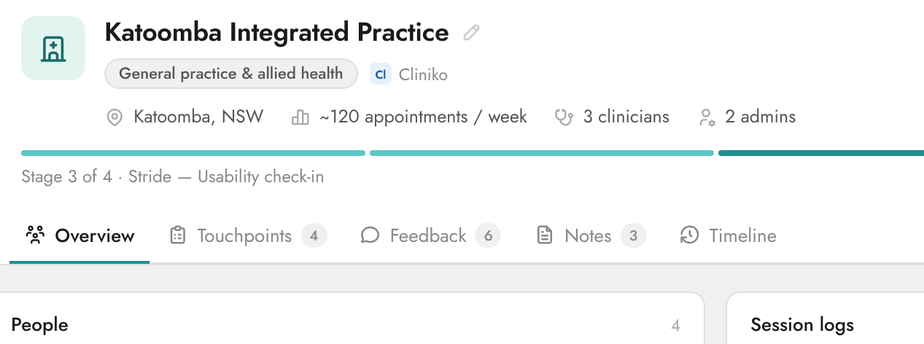 Design partners and product–market fit
Researching how practices really work, and keeping them with us all the way to paying.
MVP shipped, partners converted
I left in November 2026, with the MVP in practices' hands and the design partner program converting. 90% of onboarded partners became paying customers.
What I took with me:
- When AI can build almost anything quickly, the more valuable skill is deciding what's worth building, and how.
- Design belongs where the code lives. Direct throughput into the codebase brings design properly into the development team, with no translation layers.
- Customers can be generous with their time, when they feel heard and can see their input change the product.